













What is the WhatsApp Business API, and when does your business need it
The app versus the API, how every message is charged since October 2026, and what you would really pay in Egypt and Saudi Arabia, with a cost simulator.
On this page12
- The common mistake
- The big picture: three versions of WhatsApp
- An office comparison
- Try it: the cost simulator
- How messages are charged
- A worked example: a perfume store in Egypt and one in Saudi Arabia
- Three things most guides skip
- Checklist before you ask for the API
- Your task
- Questions people ask
- Free resource
- Next step
On 1 October 2026 the maths of WhatsApp for business changed. The first 1,000 service replies a month per number are free, and everything after that is paid. Order confirmation templates are now charged even inside an open chat.
This guide is for owners of a store, clinic or service business who answer customers from the WhatsApp app. You keep hearing about the “WhatsApp API”.
You will see how the three versions differ and how each message is charged. You will also see what you would really pay, and when the free app is still the right call.
The common mistake
Many people think the API is a way to blast messages to any list of numbers. They buy “unlimited sender” tools that run on unofficial methods, and the number gets banned a few weeks later.
The official API works the other way round. You only message people who agreed to it, and every message you start uses a template Meta reviews. Your sending limit grows with the quality of your messages.
The big picture: three versions of WhatsApp
- Regular WhatsApp: for people. Not for a store.
- The WhatsApp Business app: free, on one phone plus linked devices, with a catalogue, quick replies and a greeting. Enough for a shop where one or two people reply.
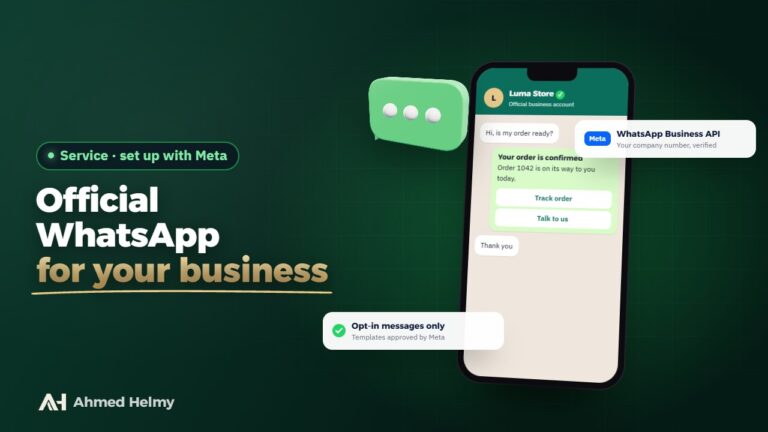
- The WhatsApp Business Platform (Cloud API): WhatsApp as a programmable service hosted by Meta. It connects your number to your store, your CRM and an AI agent, sends automated messages, and is billed per message.
An office comparison
The Business app is the shop’s desk phone: the owner answers it and pays nothing per call. The API is a company switchboard: several staff on one number, transfers, records, and a bill based on the number and type of calls.
Owning a phone is not a reason to buy a switchboard. You need one when answering by hand is what loses sales.
Try it: the cost simulator
Pick a country in the simulator, send different kinds of messages and watch when a message is free and when it is charged. The second tab asks four questions and tells you which version fits, and the third is a monthly calculator.
How messages are charged
Since 1 July 2025 Meta charges for each delivered message, not per conversation. Every message has one category, and the category sets the price:
| Category | Example | When it is paid |
|---|---|---|
| Marketing | An offer, a discount, an abandoned cart reminder | Always, except inside the free WhatsApp ad window |
| Utility | Order confirmation, shipping update, appointment | Always since 1 October 2026, even inside the service window |
| Authentication | A login or phone verification code | Always, except inside the free ad window |
| Service | Your free-text reply to a customer’s question | After the first 1,000 a month per number |
| Meta Business Agent | A reply from Meta’s AI agent | USD 2 per million tokens, in every case |
The service window: 24 hours
When a customer messages you, a 24-hour window opens and resets with each new message from them. Inside it you reply in free text. Outside it you can only send a Meta-approved template, and each template has a category and a price.
The free ad window: up to 7 days
A customer may arrive from a click-to-WhatsApp ad on the phone app. If you reply within 24 hours, a free window opens for up to 7 days. Every category is free during it, except Meta Business Agent messages.
That is why ads that open a chat are costed differently from ads that send people to a page.
The price follows the customer’s country
The rate is set by the country calling code of the customer’s number, not by where your company is. These are Meta’s list rates per message in USD, from the rate card in force since 1 October 2026:
| Country | Marketing | Utility and authentication | Service after 1,000 |
|---|---|---|---|
| Egypt | 0.0644 | 0.0036 | 0.0036 |
| Saudi Arabia | 0.0576 | 0.0107 | 0.0107 |
| UAE | 0.0576 | 0.0157 | 0.0157 |
Utility rates drop after 100,000 messages a month and authentication after 300,000. Meta only changes rates on 1 January, 1 April, 1 July or 1 October.
A worked example: a perfume store in Egypt and one in Saudi Arabia
The store and the volumes are made up. Each month it sends 3,000 marketing messages, 1,500 order confirmations, 400 verification codes and 2,500 service replies, from one number:
| Item | Customers in Egypt | Customers in Saudi Arabia |
|---|---|---|
| 3,000 marketing | USD 193.20 | USD 172.80 |
| 1,500 order confirmations | USD 5.40 | USD 16.05 |
| 400 verification codes | USD 1.44 | USD 4.28 |
| 2,500 service replies (1,000 free) | USD 5.40 | USD 16.05 |
| Total | USD 205.44 | USD 209.18 (about SAR 784) |
In Egypt, marketing is 94% of the bill. The decision that moves the cost is not the API itself; it is how many campaigns you send and to whom.
The rule: read a WhatsApp bill from the marketing line first.
Three things most guides skip
The sending limit covers your whole business
The limit counts the customers you start a message with outside a service window in 24 hours: 250, then 2,000, 10,000, 100,000, then unlimited. It applies to your whole Meta business portfolio, not to each number.
Verifying your business in Meta takes you to 2,000. After that the limit rises by itself when your message quality stays high and you use at least half of it within 7 days.
Coexistence: one number in the app and the API
You can connect your current Business app number to the API without losing it. One-to-one chats from the app stay free and API messages are billed at API rates. The last 180 days of chats move across if you agree.
In the app you lose broadcast lists, disappearing messages, view-once messages and live location. That number’s throughput is fixed at 20 messages a second.
AI on WhatsApp
Meta’s platform terms (last updated 23 September 2026) bar AI companies from offering a general-purpose assistant over WhatsApp. Your store can still use an AI agent that serves its own customers. It cannot train models on WhatsApp data except for its own exclusive use.
Worth knowing
Meta does not bill WhatsApp in Egyptian pounds. There are 16 billing currencies, including USD, SAR and AED, and the currency is chosen once when the account is created. So an Egyptian store budgets in dollars and watches the exchange rate.
Source: WhatsApp pricing in Meta’s developer documentation
Checklist before you ask for the API
- I know how many marketing messages I will send a month, to whom, and with what consent.
- I have a clear way for customers to opt in (a form, the checkout page, or a message from them).
- My business is verified in Meta Business, or I know the verification steps.
- I have decided whether to keep the app on the same number with coexistence.
- I know who replies inside the 24-hour window, and what the automated agent does and does not do.
- I have estimated the monthly bill and know it is billed in USD or SAR.
Your task
Take one month of WhatsApp activity and count the offers, confirmations and replies you sent. Put the numbers into the calculator above or the free sheet, then answer the four questions to see which version you need now.
Questions people ask
Is the WhatsApp Business API free?
Connecting has no Meta fee, but messages are charged by category and the customer’s country. Customer messages to you are free, and so are the first 1,000 service replies a month per number. Messages inside a WhatsApp ad window are free for up to 7 days.
Can I keep my current number?
Yes. With coexistence you connect your Business app number to the API and keep chatting in the app. Broadcast lists and a few app features stop working.
Can I send offers to all my customers’ numbers?
No. The WhatsApp Business policy requires the customer’s opt-in before you message them. Messaging people who did not agree lowers your quality rating and stops your limit from growing.
What does a WhatsApp API message cost in Egypt and Saudi Arabia?
At 1 October 2026 rates, a marketing message is USD 0.0644 in Egypt and 0.0576 in Saudi Arabia. Utility and authentication are 0.0036 in Egypt and 0.0107 in Saudi Arabia.
Can an AI agent answer my customers?
Yes, to serve your own customers. What is barred is offering a general-purpose AI assistant as a service on WhatsApp. Using chat data to train models beyond your own use is barred too.
Free resource
An Excel sheet that estimates your monthly bill by country, number of phone numbers and category. The checklist and the four questions are on a second page.
Next step
If the questions say you need the API, connecting your number to Meta, setting up templates and verification is a one-payment service I deliver. See the WhatsApp API setup service.