




















The Lean Startup cycle in 4 steps: test an offer before you spend on it
On this page3
Ads do not tell you whether an offer is good. They carry a good offer or a bad one to more people, faster. So test the offer before you pay to promote it.
This guide is for a business owner about to launch a new product, service or package and pay for ads to sell it.
The usual mistake: spending to find out
The usual order is plan, build, brand, then advertise. Months of work and money go in before one customer says yes or no. If the answer is no, little is left to change course with.
A big company can absorb a failed launch, because the rest of the business covers the cost. A small business that goes all in on an idea that fails may not survive it.
A plan rarely survives its first contact with customers. The Lean Startup method, from Eric Ries’s book The Lean Startup, starts from that fact. It borrows from Toyota’s lean manufacturing: cut waste, and put money only where it has been shown to work.
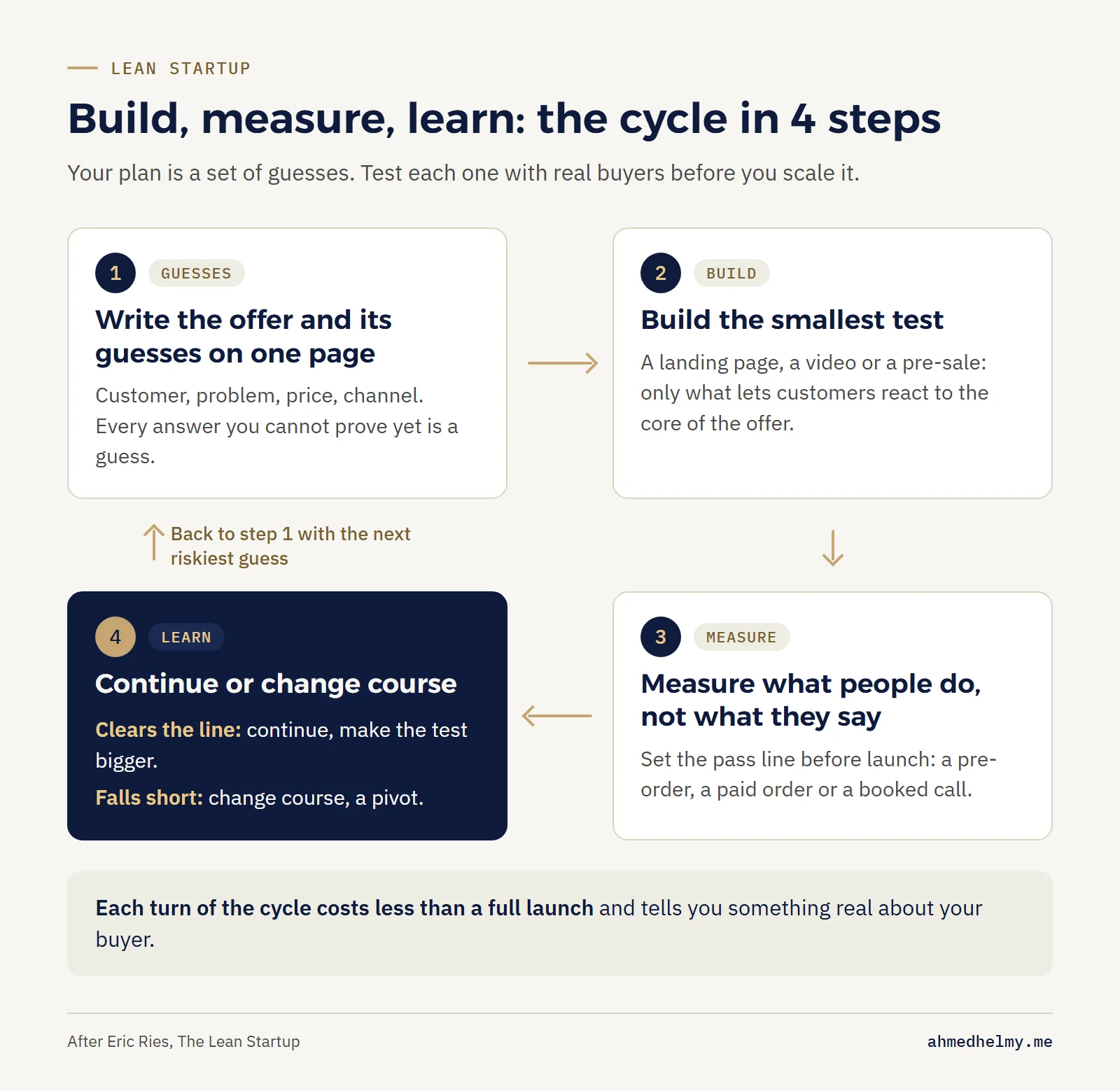
Your plan becomes a set of guesses, and you test each guess with real buyers before you scale it. The cycle is build, measure, learn: build the smallest thing customers can react to, measure what they do, and learn whether to continue or change course.
The cycle in 4 steps
1. Write the offer and its guesses on one page
Alexander Osterwalder, co-founder of Strategyzer, designed the Business Model Canvas: one page with the 9 blocks every business runs on. Fill it in for your offer, with one short answer per block.
- Customer segments: who is it for, and which customers matter most?
- Value proposition: which problem does it solve better than what they use today?
- Channels: where will they hear about it, and which channel costs least?
- Customer relationships: automated, like an online store, or personal, like a local shop?
- Revenue streams: one payment, a subscription, or a free tier with a paid upgrade?
- Key resources: which assets, skills and people does it need?
- Key activities: what must you be good at to deliver it?
- Key partners: which suppliers or partners do you depend on?
- Costs: which costs are fixed, which vary, and which are largest?
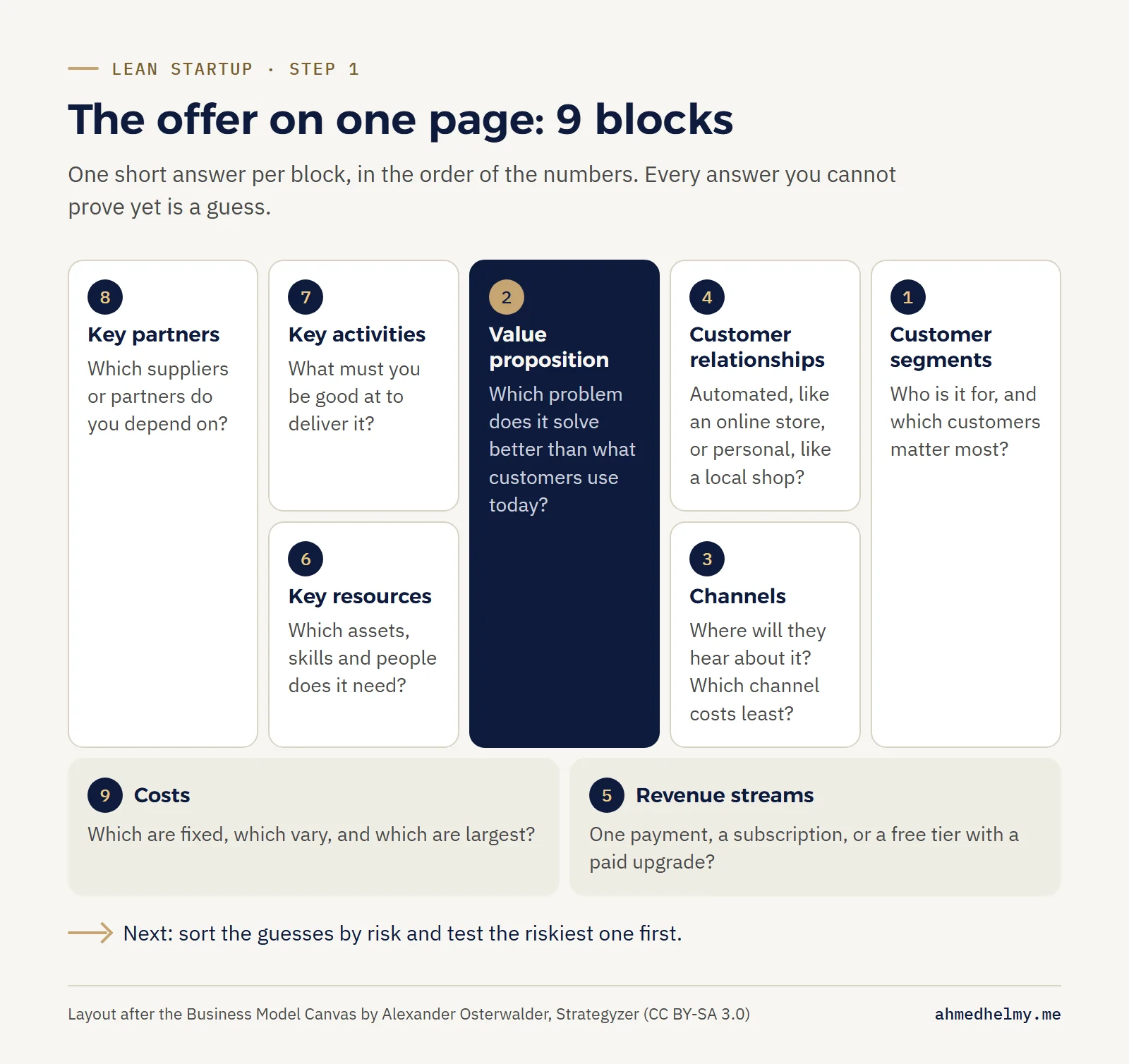
Every answer you cannot prove yet is a guess. Take a new smartwatch: who would wear it, why they would pick it and what it costs are all guesses until buyers answer.
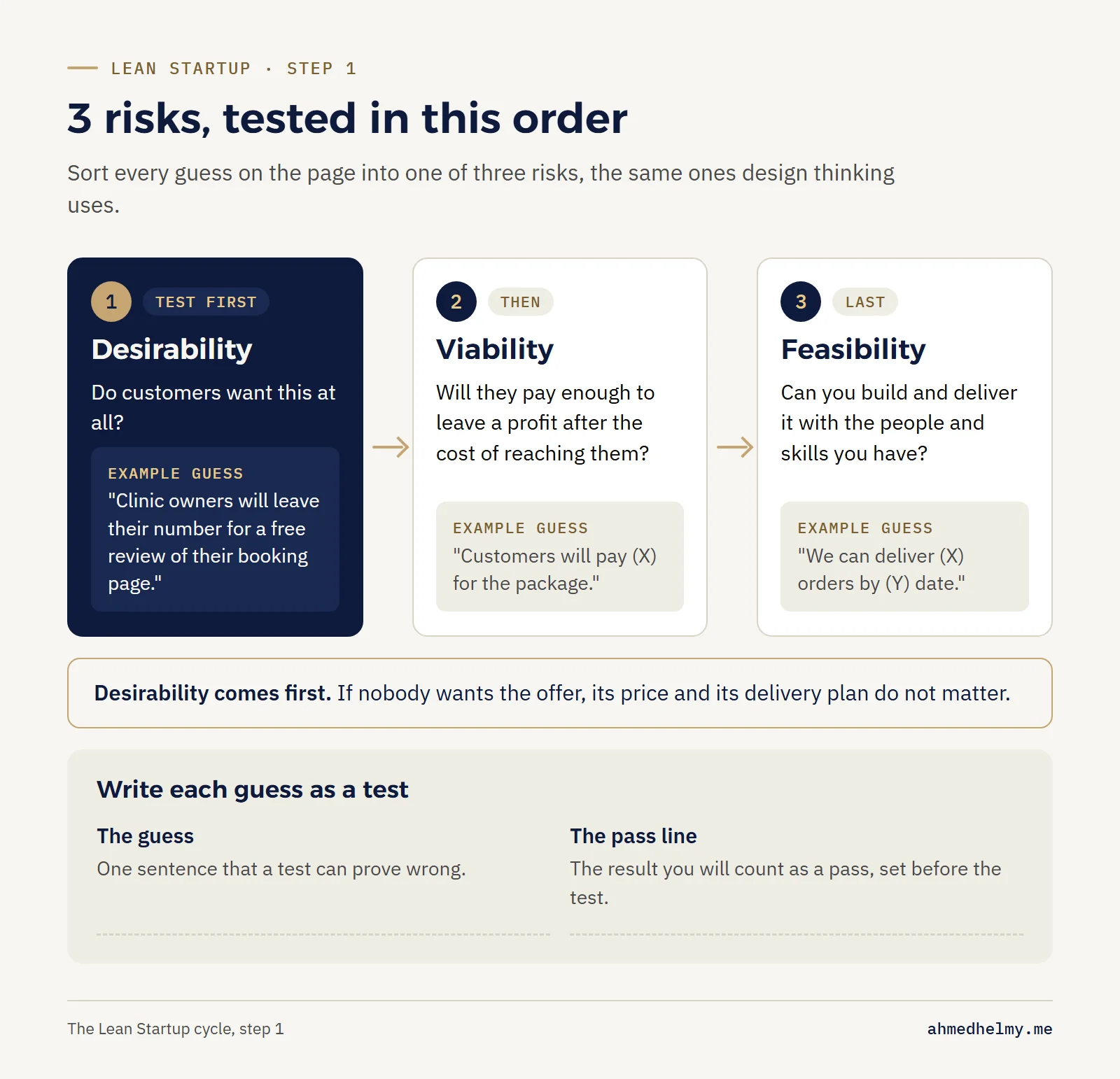
Sort the guesses into 3 kinds of risk, the same ones design thinking uses. Test them in this order:
- Desirability: do customers want this at all? Example: “Clinic owners will leave their number for a free review of their booking page.”
- Viability: will they pay enough to leave a profit after the cost of reaching them? Example: “Customers will pay (X) for the package.”
- Feasibility: can you build and deliver it with the people and skills you have? Example: “We can deliver (X) orders by (Y) date.”
Desirability comes first. If nobody wants the offer, its price and its delivery plan do not matter. Write each guess as a sentence that a test can prove wrong, with the result you will count as a pass.
2. Build the smallest test
Ries calls it a minimum viable product, or MVP: the version that teaches you the most about customers for the least effort. It does not have to be a product at all.
A landing page. One page that describes the offer, shows the price and asks for a sign-up, a pre-order or a WhatsApp message. A visitor who will not leave a number is unlikely to pay.
A video. The Dropbox founders, Drew Houston and Arash Ferdowsi, made an explainer video of a product they had not finished building. Over 70,000 people left their email, so they knew people wanted file syncing before they built the servers and apps.
A pre-sale or a crowdfunding campaign. Platforms such as Kickstarter, Indiegogo and Crowdcube let early backers put money into an idea before it exists. A campaign takes work, but far less than a full launch, and you learn from people who paid.
Whatever you build, keep only what lets customers react to the core of the offer. Everything else waits until the test says yes.
3. Measure what people do, not what they say
Set the pass line before the launch, not after it. Once results are in, any number can be explained away.
Choose the action closest to money: a pre-order, a paid order, a booked call. Likes, clicks and “how much?” messages cost the customer nothing, so they prove little.
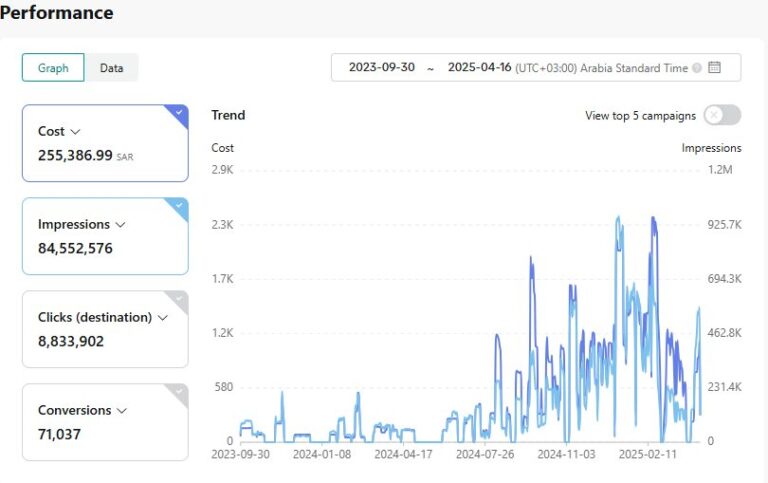
Then tie each action to its source. That is how I worked with Legend AIM, a gaming store in Saudi Arabia. Before raising spend, I set up conversion tracking on Google, Meta, TikTok and Snapchat, with an event for every sale.
From then on, each platform was judged by the sales it brought, not by its clicks. The A/B tests on the ads were read against that number too.
4. Learn: continue or change course
Read the result against the pass line you set. If the offer clears it, continue and make the test bigger. If it falls short, change course: Ries calls this a pivot.
A pivot is a new set of guesses to test, not a restart from zero. Ries describes 10 types of pivot. Here are 5 of them:
- Zoom-in: one feature draws more interest than the whole offer, so that feature becomes the offer.
- Zoom-out: the main feature draws little interest, so you rebuild the offer around a different one.
- Customer segment: the offer solves a real problem, but for a different customer than planned, for example companies instead of consumers.
- Customer need: the problem you solve matters little to customers, and a more pressing one shows up, so you adapt the offer to it.
- Platform: the offer stays the same, and the platform that delivers it changes.
After the decision, go back to step 1 with the next riskiest guess. Each turn of the cycle costs less than a full launch and tells you something real about your buyer.
Checklist before you spend on ads
- The offer fits on one page: customer, problem, price, channel.
- Your riskiest guess is written as a test that can fail.
- The pass line is set before launch, as an action: a pre-order, a paid order or a booked call.
- The test can go live within days, as a page, a video or a pre-sale.
- Every action is tracked to the ad or channel it came from.
- There is a date to decide: continue, change course or stop.
If you are about to spend on a new offer, send me the offer and the result you would call a yes. I will tell you the cheapest test I would run first.
Amazing article
Good