



Email marketing for business owners: a practical guide

On this page4
Email rarely fails because of the tool. It fails because the list was bought, or because the business had nothing to say after the first message.
This guide is for owners who sell online or take bookings and want a channel they own, not one they rent from an ad platform. It goes in order: the list, the welcome emails, what to send after that, and what to measure.
The common mistake: a bought list and nothing but offers
Some senders buy or scrape email addresses, then send promotions to people who never asked for them. That is spam. Mail providers learn to block the sender, and the domain carries that reputation into every email after.
The second mistake is quieter. A business collects real sign-ups, then sends nothing for months, or only discounts. People forget why they subscribed and stop opening.
The method, in order
1. Build the list with permission only
Every address on your list should belong to someone who asked to hear from you. Put the sign-up form where people already make decisions: the checkout, the booking form, the end of a useful article. Ask only for what you need, usually an email and a first name.
Give people a reason to sign up. A discount on the first order suits a store. A checklist or a template suits a service. I collected lead magnet ideas, each with when to use it.
Use double opt-in: the subscriber confirms with a link in the first email. The list grows slower, but every address on it is real.
2. Choose a setup that fits your size
Every email system has two parts. The sending server (SMTP) delivers the mail. The application holds your lists, builds the campaigns and shows the reports.
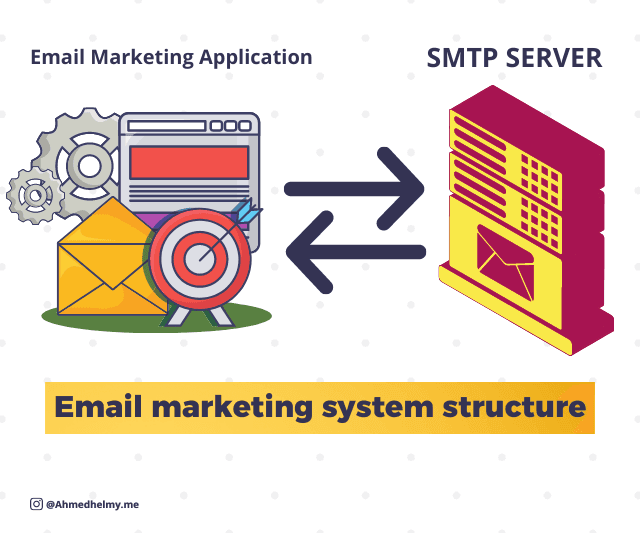
You can get both parts in one service, such as Mailchimp, systeme.io or GetResponse. These services handle the technical side, and most have a free plan for small lists. Start here if email is new to you.
Or you can build your own. Connect a sending service, such as Amazon SES, Mailgun or turboSMTP, to an application you host, such as Mailwizz or Mailster. Large volumes cost less this way. In exchange, the setup, the delivery and the maintenance are yours. Move to it when your volume pays for that work.
When you compare services, check four things. What does it cost at your list size? Does it have the features you will use: forms, automations, segments and reports? Can your team use the editor without help? How fast does support answer?
If you want to learn the technical side first, take a free course. Here is how I pick a free course worth the time.
3. Set up the sender before the first campaign
Send from your own domain, not from a free Gmail address. Add the SPF, DKIM and DMARC records your service gives you. They prove to mail providers that the email really comes from you, and without them good emails land in spam.
Use a real name and a reply address that someone reads. Replies tell mail providers that people trust you, and they bring you leads.
4. Write the welcome sequence
The first emails after sign-up get the most attention. You write them once, and the system sends them to every new subscriber. A simple sequence:
- Right away: deliver what you promised, and say what you will send and how often.
- A day or two later: the problem you solve, in the customer’s words, and how you work.
- A few days later: proof, in one customer story and what changed for them.
- After that: one clear offer with one button.
Keep each email to one idea and one link. If someone buys during the sequence, stop the sales emails. Send a thank-you and a short how-to-use email instead.
Write the subject line the way you would say it to a customer in front of you: what is inside, in plain words. Sign every email with a person’s name, not the company’s.
5. Decide what you send every month
After the welcome sequence, keep a steady rhythm your subscribers can expect. Mix three kinds of email:
- Help: a tip, a short guide, or the answer to a question customers ask you often.
- Proof: a result, a review, or a look at how the work gets done.
- Offer: a product, a booking slot or an event, with a deadline only when the deadline is real.
Most of your emails should help without asking for anything. Then the offers get read when they come.
6. Split the list by what people did
One list for everyone is where most businesses stop. Split it by action: bought once, bought twice, booked, clicked a product, took a guide but never bought. Each group gets the email that fits its next step.
Write separate emails for business buyers. A company decides for different reasons than a person buying for themselves.
7. Measure what ties to sales
- Delivery and bounces: bounced addresses hurt your sender reputation, so remove them.
- Opens: a rough signal only, because some mail apps open emails automatically and the number runs high.
- Clicks: the clearest sign that an email worked.
- Replies, unsubscribes and spam complaints: they tell you whether the list still wants to hear from you.
- Sales per email: tag every link with UTM tags, so Google Analytics shows which email brought the order.
Every few months, send one last email to people who have not opened or clicked in a long time, asking if they want to stay. Remove those who do not answer. A smaller list that reads is worth more than a big one that ignores you.
How it worked in two campaigns
At Nobles Restaurant in Riyadh, my team used email for the business side: events and catering. We wrote to corporate clients, event planners and private hosts with offers for their occasion, then followed up. Bookings for business events, weddings and private parties went up. Email ran alongside ads, influencers and WhatsApp, so I have no separate figure for it.
For Jewel Festival in Alexandria, the buyers were restaurant and café owners looking for space at the festival. My team collected their contacts and emailed them the project’s advantages and timeline. Here too, email was one channel among several.
The lesson from both: email works when the list is specific and each email is written for one kind of buyer.
Checklist for this week
- Every address on the list asked to hear from you.
- The sign-up form sits on the checkout, the booking form and your most-read articles.
- SPF, DKIM and DMARC are set on your sending domain.
- The welcome sequence is written and switched on.
- Every link in your emails carries a UTM tag.
- Bounced addresses are gone from the list.
If you want a second opinion on your setup, write to me with your list size and what you sent last month. I will tell you what I would fix first.