






How to build a marketing strategy that works without burning out
On this page5
A marketing strategy is mostly a list of things you will not do. Without that list, every channel and every idea lands on your desk, and you burn out before the market answers.
This guide is for a business owner who runs marketing alongside everything else and spends on ads without a written strategy.
The common mistake: a plan before a strategy
Many owners start with the plan: a posting calendar, a few campaigns, a new tool. A plan and a strategy are not the same thing, and mixing them up is where many launches go wrong.
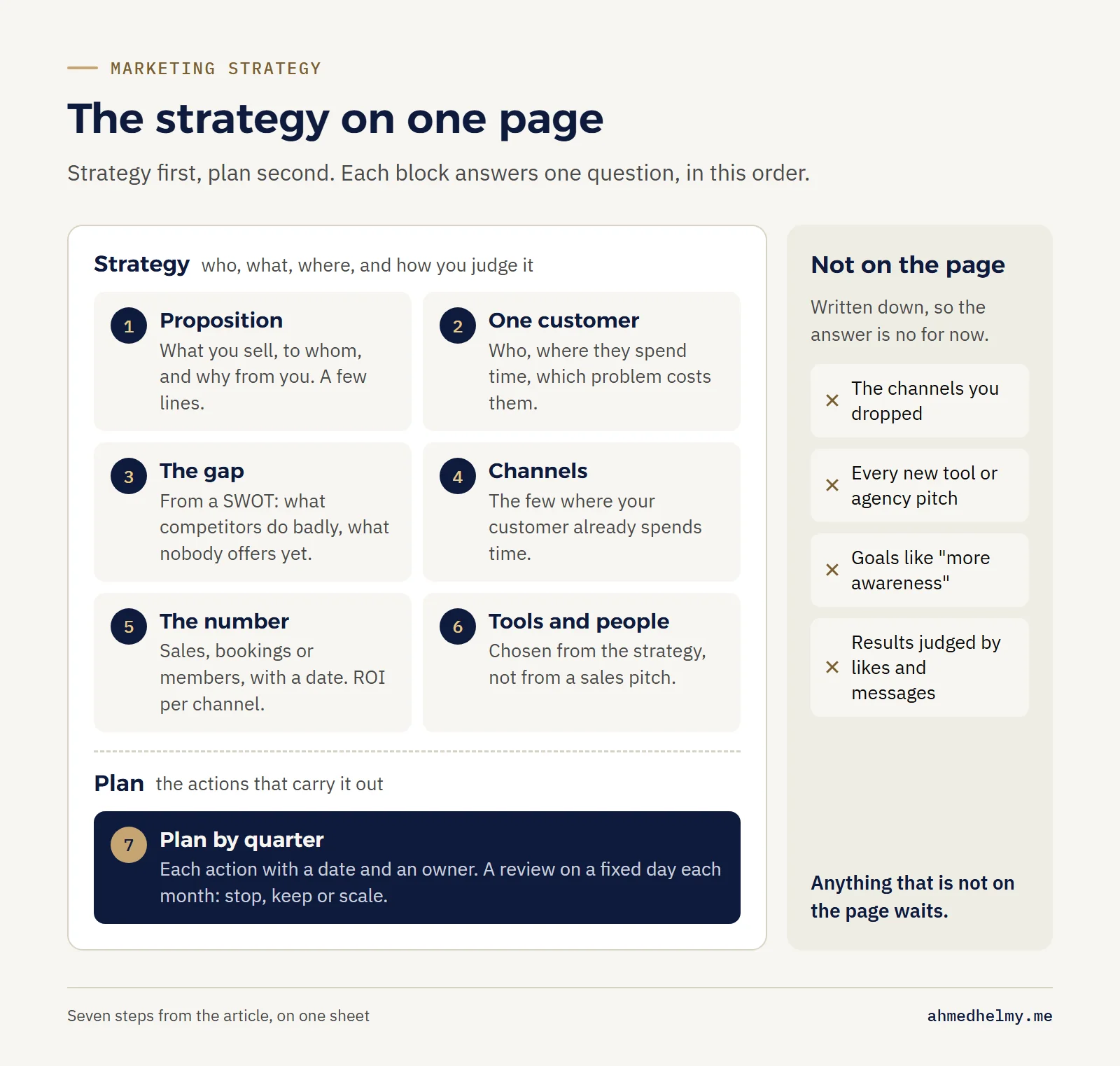
The strategy decides who you sell to, what you offer them, where you reach them and how you judge the result. The plan is the list of actions, dates and owners that carries it out. Strategy first, plan second, never the other way around.
Where the burnout comes from
Burnout in marketing rarely comes from hard work alone. It comes from doing everything at once, with no way to tell which part works.
The signs are easy to spot: the plan changes every week, results are judged by likes and messages, and every new tool or agency pitch gets a meeting. Nothing on paper says no, so everything gets a yes.
A written strategy gives you focus. You know which step comes next and why, so you make fewer decisions in a hurry and waste less money, time and effort.
How to build it, step by step
1. Write your proposition in a few lines
What do you sell, to whom, and why should they buy it from you rather than from someone else? If the answer takes a page, the strategy is not ready.
Then write how you will explain the benefit, in the words your customer uses, not the words on your price list. Read it to a customer: if they cannot say it back in their own words, it is still too vague.
2. Describe one customer in detail
Write who your customer is, where they spend their time and which problem costs them money or time. Their problem decides your message. Where they are decides your channels.
The fastest source is your recent customers. Ask them why they bought, and what almost stopped them.
For United Gym in Alexandria, my team researched the audience before building any campaign. Most customers turned out to be middle-aged men who wanted to get more active, and we built the Facebook and Instagram campaigns for them.
3. Study your competitors with a SWOT
A SWOT lists strengths, weaknesses, opportunities and threats. Fill one in for your business and one for each main competitor.
Look for what your competitors do badly, and for what nobody in your market offers yet. That gap is where your offer should stand.
4. Choose your channels and drop the rest
Pick the few channels where your customer already spends time, and say no to the others for now. This step protects your time more than any other.
World Gym in Alexandria had a limited budget, so the plan put it into search ads, social media ads and local influencers. We left print and TV out on purpose.
5. Set the number you will judge it by
Write the goal as sales, bookings or members, never as “more awareness”. At World Gym, the goal was a set number of basic and premium memberships a month, and a set number of leads a day.
Then track return on investment, or ROI: how much comes back for each riyal you spend. For each channel, track the cost per lead, the cost per sale and the ROI. A short list of leads who match your customer is worth more than a long list that never buys.
6. Choose tools and people after the strategy, not before
The strategy tells you what to buy and whom to hire. Do you need software to measure results, or a specialist for ads, content or design? Answer from the strategy, not from a sales pitch.
A small team of specialists does more than one person doing everything. Running ads, content, design and reports alone is the shortest road to burnout.
7. Turn it into a plan by quarter
Now write the plan: each action with a date and an owner. Build your sales forecast by quarter and by half year from the same strategy, so the targets and the actions match.
Use a reporting tool that shows how each channel is doing at any time. Review it on a fixed day each month, and decide what to stop, what to keep and what to scale.
What the page looks like
Here is a sketch for a dental clinic in Riyadh. It is an illustration, not a client.
- Proposition: cosmetic dental work, with the full price agreed before the first visit.
- Customer: working adults who want a better smile and fear hidden costs.
- Gap: nearby clinics post photos of results but never show prices.
- Channels: Google search ads, Instagram and the Google Business Profile. No billboards for now.
- Number: first visits booked each month, and the cost of each one.
- Tools and people: a booking form with tracking, and one person who answers WhatsApp the same day.
- Review: the first Sunday of each month.
That is the whole strategy. Anything that is not on the page waits.
Checklist for this week
- Your proposition fits in a few lines.
- One customer is described: who, where, which problem.
- A SWOT is done for your business and your main competitors.
- Your channels are chosen, and the dropped ones are written down.
- The goal is a number of sales, bookings or members, with a date.
- ROI is tracked per channel, not only the number of leads.
- The plan lists actions, dates and owners by quarter.
- A monthly review day is in your calendar.
If you spend on ads and cannot say which channel brings your sales, send me your monthly spend and your sales from the contact page. I will tell you which part of the strategy I would fix first.